
A few of my favorite things
PAINT
You have all tried Daniel Smith pigments now, so you have a feel for how a good pigment SHOULD be able to perform. There are other great brands, including:
Holbein (don't flow as well as DS)
M. Graham (uses honey as binder compared to arabic gum, sticky consistency, takes a lot longer to dry)
Sennelier (also honey binder)
Schmincke
QOR (wild flow, vibrant color, often chalky opaque)
Winsor & Newton (very few are light-fast, they fade in time, consider the colors).
If you want to buy more Daniel Smith pigments here are some places you can find them:
Jerry's Artarama local-ISH stores (Arlington, Dallas, online) carry them in individual tubes
Online…including Amazon for real, Google is your friend, they are available MANY places online. The 15ml tubes are far more cost-effective for what you get. If you have any desire to paint BIG, or use a lot of dark shades, investing in tubes is helpful, and saves time mixing from those dry pans.
Basic Primary Set ~$30 for 3 colors: Perylene Red, Hansa Yellow Medium, French Ultramarine. You can do a lot with this set of 3 colors. 15ml large tubes.
Primaries in Warm and Cool ~$34 for 6 tiny colors: French Ultramarine, Quin. Rose, Pyrrol Scarlet, Hansa Yellow Light, New Gamboge, Phthalo Blue (GS) As you know by now, you can do a ton with these 6 colors! These are little tiny tubes, about 5ml, and will fill half pans like are in your custom palette about 1 1/2 times.

The Custom Palette
The palette I build for you includes the following colors:
Yellows: Lemon Yellow, Hansa Yellow Medium, Quinacridone Gold
Reds: Pyrrol Scarlet, Pyrrol Crimson, Quinacridone Rose
Blues: Phthalo Blue Red Shade, Phthalo Blue Green Shade, Ultramarine
Neutrals: Raw Umber, Burnt Sienna, Quinacridone Burnt Scarlet, Italian Deep Ochre, Payne's Grey
That’s…not many colors. Red, yellow, blue, and neutrals? You’re right…it’s limited.
Let’s recap. WATER MOVES. On top of your paper, across your paper, into your paper…and it takes pigment with it. If you’re going to watercolor, the water is going to move your paint. It's the magic and the torture of this particular medium!! Because water moves colors together, they mix. Of course. But color theory dictates what happens when colors mix…purple and yellow always make brown…orange and blue always make brown…red and green always make brown…red/yellow/blue make grey, or black if you use enough.
It’s a curse of watercolor…making MUD.
I’m convinced it doesn’t have to be!!! We study with primaries to understand what happens when PURE colors, pure pigments, mix. We study by layering colors to change what we see underneath. We study with pure colors so there are no surprises. Only intentional happenings.
Water Moves. You can’t stop it. So instead, we learn to go with the flow.
As you begin to grow your collection of paint, I recommend you start with these three colors:
Quinacridone Gold
Quinacridone Rose
Phthalo Blue (either red shade or green shade)
You can mix 98% of everything with these three! It's what we use to go black, and it’s what I use to go dark in any color/shade.
Do keep in mind, if and when you branch out into new colors, there are many, many colors available that are not as lightfast (remain true color over time, and with light exposure), and that are not pure pigments (multiple pigments in the recipe contribute to more mud because of that!). By all means, experiment! Just look to see what you're trying ;) You can find out lots about the Daniel Smith watercolors in this brochure!
paper
Ahh, paper! Every artist has their own preference. The “best paper” depends somewhat on the style the artist likes to paint. You all got to try several in Fundamentals class, and experience the difference between papers.
Paper comes in many sizes, it comes as loose sheets and it comes in blocks (stacks of paper with glued edges). I often buy full sheets when they're on sale (22x30) and cut them up. It's the best price/sq. inch, but it is labor-intensive! Thankfully with all the different options, you should be able to find a size and price point that fits your watercolor practice.
NOTE: the “Budget” paper noted very first is the same stock you used in Fundamentals, and is the paper I use to produce worksheets. It’s the best cheap paper I’ve found, and for abundant practice will do 75% of what good paper should do. For a ‘real painting’ or one you’re planning to expend more time and technique, I do recommend using the best paper you can afford. It’s a beautiful and worthwhile difference!!
fabriano
“Budget” paper
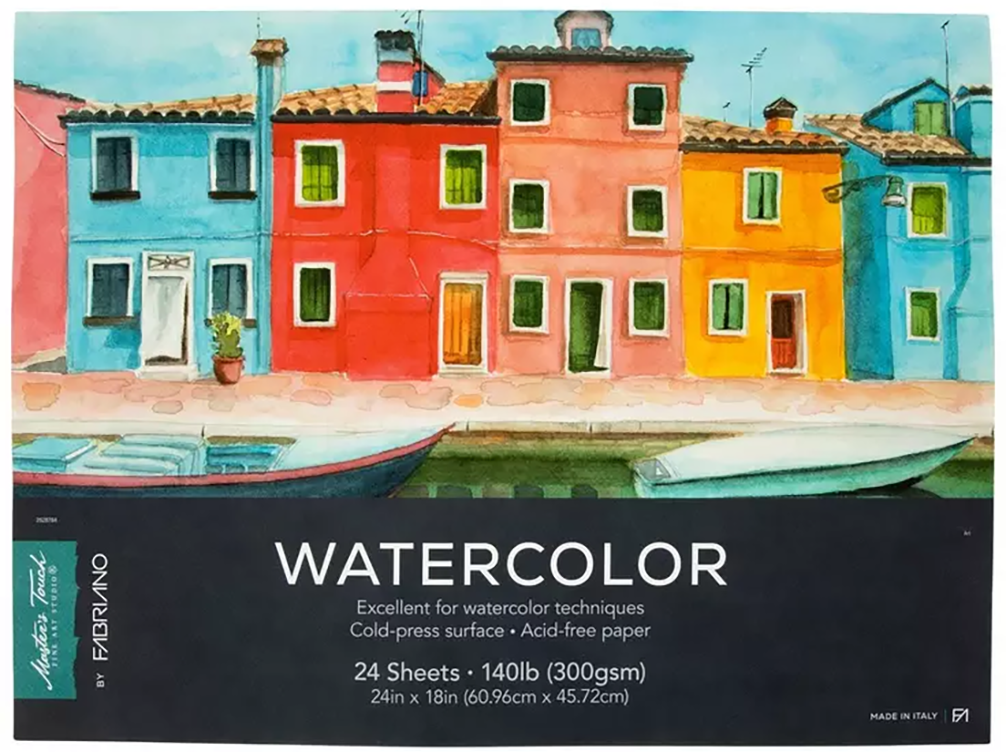

Some highlights of the Fabriano Master’s Touch Paper:
Will do 75% of what GOOD paper will do
It’s cheap enough to paint through LOTS of practice
Available in many size blocks
Goes on sale 40% off every other week!
This is a staple paper for classes where we’re doing extensive rote work, worksheets, or practice exercises. It’s affordable enough to do that! I do recommend using a GOOD paper for paintings where you plan to expend a good deal of time and technique, however, it makes a difference.
NOTE: I do not recommend any of the other Master’s Touch watercolor products…just this Fabriano-made paper!
fluid 100
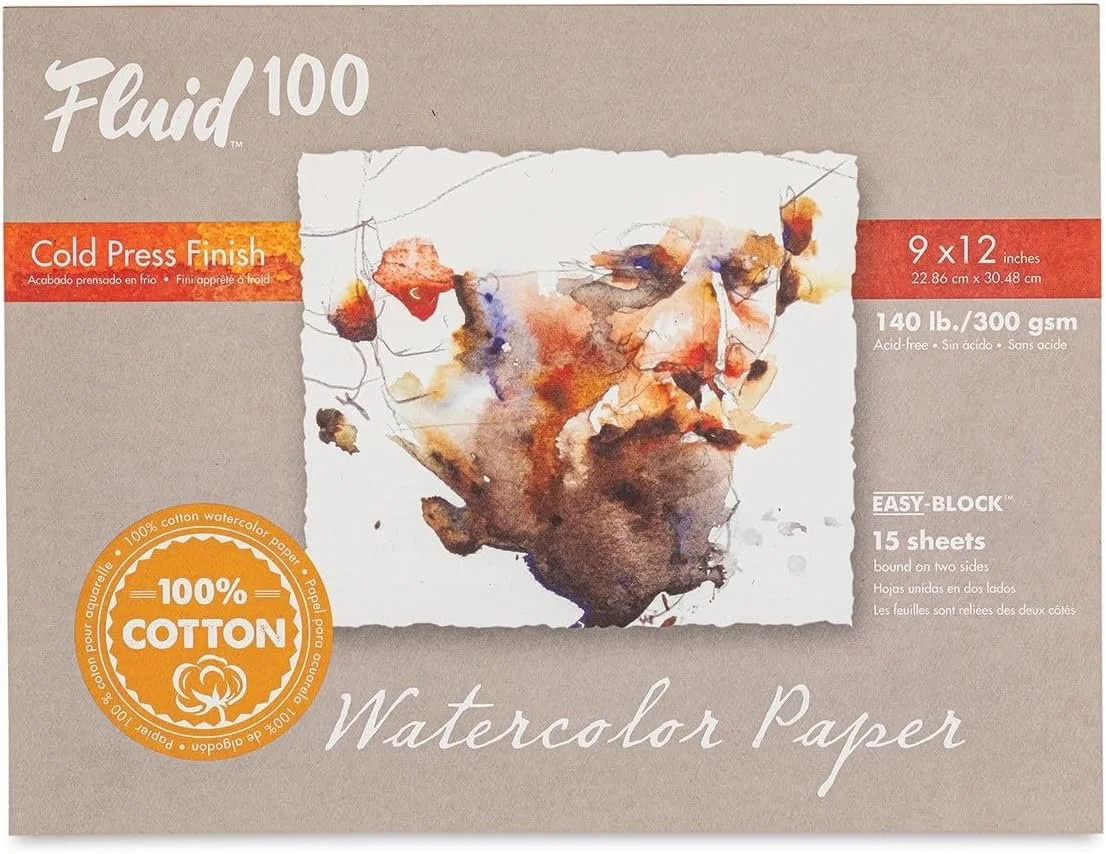
Some highlights of the Fluid 100 Paper:
Handles water well without destroying the surace
100% cotton
“Thirsty” paper, takes and holds a lot of water for beautiful soft blends
This was an early staple for me, I used it often for tutorials and practice where I needed a better quality paper, especially when wet-in-wet techniques and lots of water are involved. Has the feel of a good paper, forces more water awareness to get smooth blends, and is a step up from the budget paper while staying a little more budget-friendly than the BEST papers.
fabriano
artistico
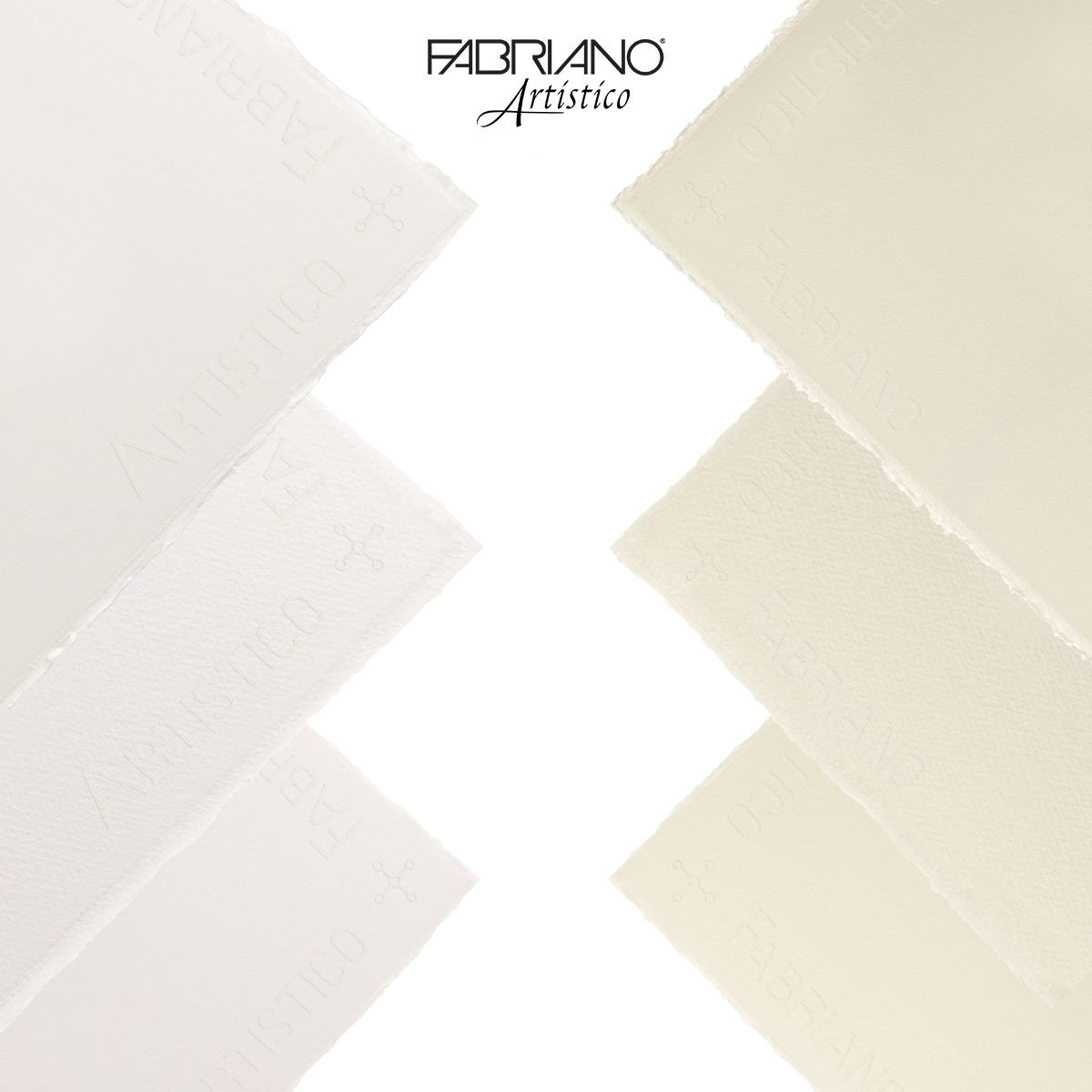
Some highlights of the Fabriano Artistico Paper:
Works for a good 80% of everything “I” do
Available in 140lb. and 300lb.
Comes in White and Extra White
Available in Cold Press, Hot Press, Soft Press, and Rough
100% cotton, handles water beautifully
This is a staple paper in my world. 140lb. Cold Press is the go-to paper.
Baohong
master’s Choice
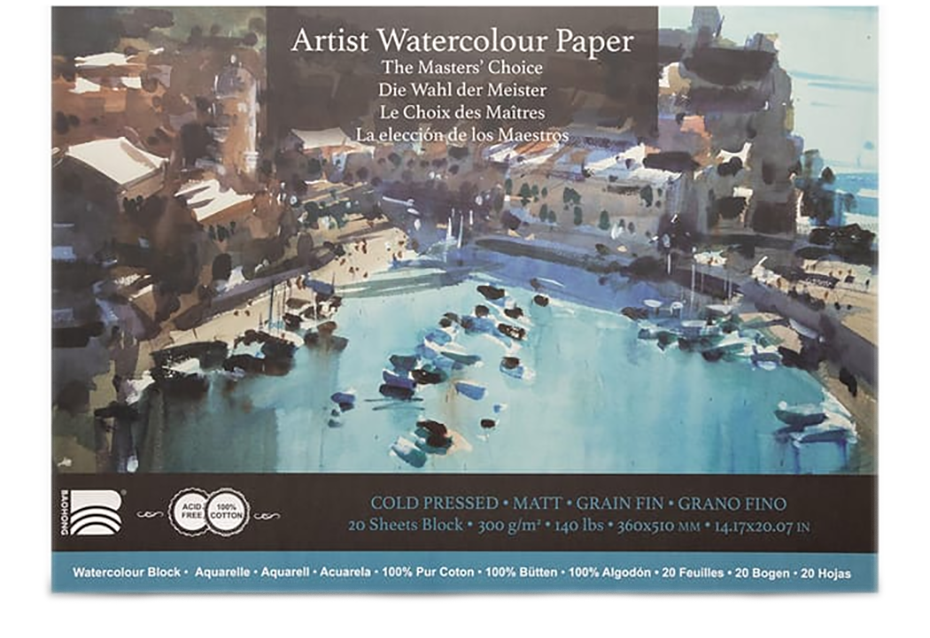
I don’t know if you’re supposed to have favorites…but this is mine! I absolutely LOVE this paper! A work that needs to have ultra-vibrant colors?! This paper is more vibrant, presenting color than ANY other one I've used. Need beautiful fades and blends that DON'T suck pigment to the edge of water areas?! This is the ONLY one I've used that can do that. The Cold Press and Rough are an organic hand-made surface, with NO roller stamping or patterning. The texture requires a bit of detailed tidying up if you're attentive to that, it's more effort to paint in tiny details over all those little mountains in the paper :D It picks up dry brush beautifully, for the exact same reason! The texture is incredible! In addition, the Hot Press is SILKY smooth, and just as vibrant as far as color-treatment.
Some highlights of the Baohong Master’s Choice Paper:
MOST vibrant color
Feels thicker than comparable 140lb., handles water incredibly well!
Ultra-smooth color blends and fades
Stays wet longer, incredible length of wet working time without ruining the integrity of the paper
Available in Cold Press, Hot Press, and Rough
100% cotton
It’s my favorite, what can I say?! 140lb. Cold Press is the go-to for this one, but I’m learning to love the 140lb. Hot Press as well.
brushes
When it comes to watercolor brushes, it's MOST important that they be SOFT, flexible, and able to flow with the water in a sense.
Slippery bristles? These tend to come on cheap brushes. The filament has no texture to grip the watercolor, and thus drop pigment in puddles, rather than releasing it in an even smooth manner across the paper.
Stiff bristles? These can be cheap, but most often they are for oil or acrylic…completely different media! Stiff bristles shove the pigment around rather than encourage flow (and leave scratchy marks while they destroy your paper fibers!)
Best Budget Brushes:
A couple of types of brushes below are noted as ‘budget friendly’. While a single brush costing $6-$12 may feel pricey, the brushes noted here are the best I’ve found that accomplish what a good watercolor brush SHOULD accomplish, at the best price.
In cheaper brushes, you often find the slipper/stiff issues noted prior. I try to get you guys setup so that the materials don’t hold you back.
DO NOTE, there are many brands of wonderful watercolor brushes in the world, at an ever-increasing price point from what you find here. (Escoda, Isabey, Winsor and Newton, etc.) I’ve tried quite a few, loved fewer, and thus my recommendation remain. I want to help you paint well. I realize affordable is a part of that picture.
Raphael
soft aqua


Some highlights of the Raphael Soft Aqua brushes:
My recommendation for a 1st brush to start with
Very soft, makes a beautiful wash!
Can twist or chisel into a moderate point for details
The Round #10 is a great brush to start! It’s what I currently include in every student kit.
In addition, the #4 Quill is the best budget quill brush that I’ve found! When painting large areas and washes, you need to be able to paint more, faster, to avoid the inevitable line from drying paint. Some highlights of this quill:
Holds a large load of paint
Maintains shape and point rather than flaring out while painting
Even smooth drop of pigment in large washes
Doesn’t splash!
Can chisel into a FINE edge for reaching details along edges of washes
NOTE: I don't care for the tiny detail brushes in this series, they are sft and too squiggly and soft to be very precise.
Princeton
Velvetouch

Some highlights of these brushes:
Stiffer bristles easily snap back to a point, making them good for precise details, the sharp point is nice for clean edges or thin lines
Stiff bristles makes them WORSE for big washes, as the bristles drag the pigment and leave more marks behind
Hold a fair load of pigment.
I LOVE their Round #1 , Round #2 and Round #3/0 for tiny details.
Silver
black velvet

Some highlights of these brushes:
A heavy-duty reliable brush, I did 80% of everything with these for many years
Great softness for smooth washes
Twists into a good point for details
The Round #4 is a great little brush, and Round #8 gets credit for painting many of my early works, and parts of every painting to this day.
NOTE: I don't care for the tiny detail brushes in this series, they are long and too squiggly and soft to be very precise.
trekell
Protégé 7500

Some highlights of these brushes:
Fairly multi-purpose brush, just stiff enough it’s not my favorite for washes
Holds an excellent point for details
Releases paint nicely, more like a sable brush
The Round #6 is a versatile little brush. Due to the fantastic point, it’s a work horse on detailed paintings. Harder to find, and not readily available at most stores.
borciani bonazzi
unico infinito 850

The Unico Infinito 850 series by Borciani Bonazzi are FABULOUS brushes! They are quills, so the hairs are bound in plastic wrap with metal wire wrapping rather than a solid metal ferule.
Some highlights of these brushes:
Incredibly comfortable to hold!
Flat side avoids rolling across the table
SOFT bristles make the most fabulous splash-free washes
Chisel to an incredible sharp wedge for details
I LOVE them all, but the Quill #4 is the one I grab most often. It is small enough to be moderately priced, but big enough to handle large washes with ease.
NOTE: I don't care for the green and blue wrapped detail brushes in this series, they are incredibly soft, and I think better suited for calligraphy or ink use.
raphael
kolinsky sable 8408

The Raphael Kolinsky Sable 8408 series are the cream of the crop (and price tag!) among my brushes. There are not many in the US, and import from the UK can be both costly and take a long time. I go in with artist friends. However, they are a PREMIERE brush. As we discuss in class, the Kolinsky Sable mink hair is PRIME for watercolor brushes! The individual hair fibers boast a thicker belly and tapered point. Each hair is covered with thousands of tiny scales that serve as ‘pockets’ for your paint load.
Some highlights of true Sable hair brushes:
Incredibly large belly and SHARP point
Beautiful washes from this soft hair
Hold 4x the amount of paint, compared to similar-sized synthetics
Sable hair holds loads of pigment and lays it down in the most even smooth brush stroke…and it brushes forever, and ever and ever.
I LOVE all Kolinsky brushes, but reach most often for the Round #2 or the Round #4 . Worth noting, these brushes hold SO much paint, a small #2 or #4 does the job of a #8 or #10 in other round brushes. The fine point also does the job of your #3/0 or #0 detail brush! To use a big sable brush, you either are putting down a LOT of paint in big washes, or wasting a LOT of paint in the water bucket between little paint strokes.
NOTE: the end of the brush handle is cream color not orange! The 8404 series with the orange end boast a thicker belly and rounder vs. pointy tip. These two series are often listed together.
Nichiban 241 Masking Tape this is the best ‘budget’ tape I've used, and doesn't destroy your paper surface when removed. We used 12mm in class, the wider width 18mm is helpful for large paintings with more tension when wet.
Amazon “White” Tape this is the new white tape we’ve been testing in class! The pack comes with 5 widths, which makes it awfully handy for several applications. So far, it’s worked well on short term application for clean edges, and no tearing with removal. If it holds up over time, we’ll leave it on the list…if it dissappears, it’s because the tape has failed.
Pebeo Gum Pen this is the masking fluid pen we tried in class. It's my #1, feels like I waste FAR less masking fluid! And, it's the only way to achieve hair fine lines, in my experience.
Plastic Eraser Mono by Tombow traditional gum erasers eat up paper, pink erasers leave stains. SOFT plastic is best to remove graphite after a painting is complete.
Plastic TEENY click style erasers by Tombow for small details, or making sure you don't distubr large areas, these click-pencil style erasers are a gem!
Graphite Transfer Paper most important part, is that you find WAX-FREE, so that you can erase and remove lines after painting is complete and dry. Hobby Lobby has some wax-free but it is SO hard, it kills your hand and still barely transfers. Save yourself, skip it. MyArtScape has the best. Use the link below:
Other stuff
Things I use and love (if I forgot something, or you have a question, please reach out!):
Daisy Ceramic Palette with 7 wells, this versatile little thing is a workhorse. I have several in use at any given time!
Rectangle Large-Well Palette this is my go to now. It's a 14-well ceramic palette nestled in a cushioned tin palette. Great for travel, big enough wells to fit all the brushes. It costs a bit to FILL it up...but the fill lasts forever!!!! The wells are filled as noted below. You'll notice, some of the 'standard' palette paints are missing. This is just the limited set I like :D
1 - Lemon Yellow, Hansa Yellow Med, Quin Gold, Burnt Sienna
2 - Save these big wells for mixing
3 - Pyrrol Scarlet, Pyrrol Crimson, Quin Rose, Quin Burnt Scarlet
4 - Phthalo Blue Red Shade, Phthalo Blue Green Shade, Ultramarine, Payne's Grey
Small Ceramic Circle Stacking Palettes These are the little round palettes we use often in class. This pack includes (10) round palettes, with two lids so you can keep them in 2 separate stacks and keep the dust out.
Brush Shaper and Restorer This is my favorite way to re-shape brushes as they wear down a bit, or get stored damp and bent. *oops* One little jar goes a LONG way!
Brush Holder I don’t like putting the caps back on my brushes, because they often catch a bristle or more, and bend them backwards and miss shape it. How much prefer to keep them in a holder like this, with the brushes are protected, and easily able to be transported. (you want the medium size not the large one! Large is very long for oil brushes.)
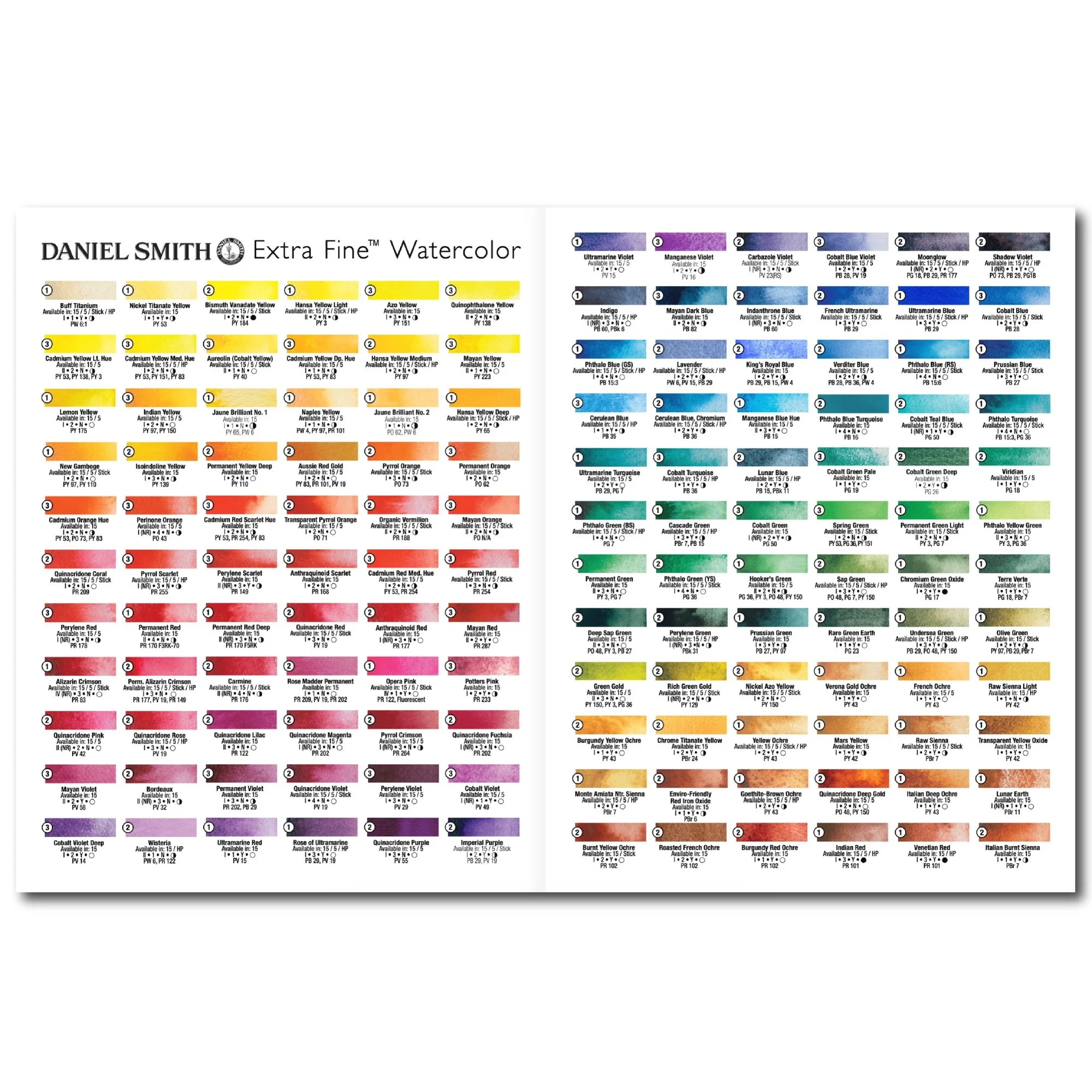
Daniel Smith Color Brochure
FREE Pdf DownloadWith a vision for building something meaningful, our founder brings a blend of big-picture thinking and hands-on experience. They set the tone for everything we do.